
Crop Irrigation
Set irrigation water quality by crop and cultivation system. Specify RO or blending where salinity requires it and adjust nutrient recipes to the treated water.
Design water quality around the job it needs to do, from crop irrigation and greenhouse cooling to cleaning and domestic supply.
Start with laboratory water analysis and peak demand. Shared pretreatment can feed separate treatment and distribution lines, with desalination sized to the uses that need it.
Set irrigation water quality by crop and cultivation system. Specify RO or blending where salinity requires it and adjust nutrient recipes to the treated water.
Use suitable filtered or softened water for evaporative cooling and wash-down, subject to equipment requirements.
Where included, provide a dedicated treatment, disinfection and storage line designed to meet applicable drinking-water requirements.
Lined galvanized-steel tanks, level sensors and pump controls buffer demand and support initial settling.
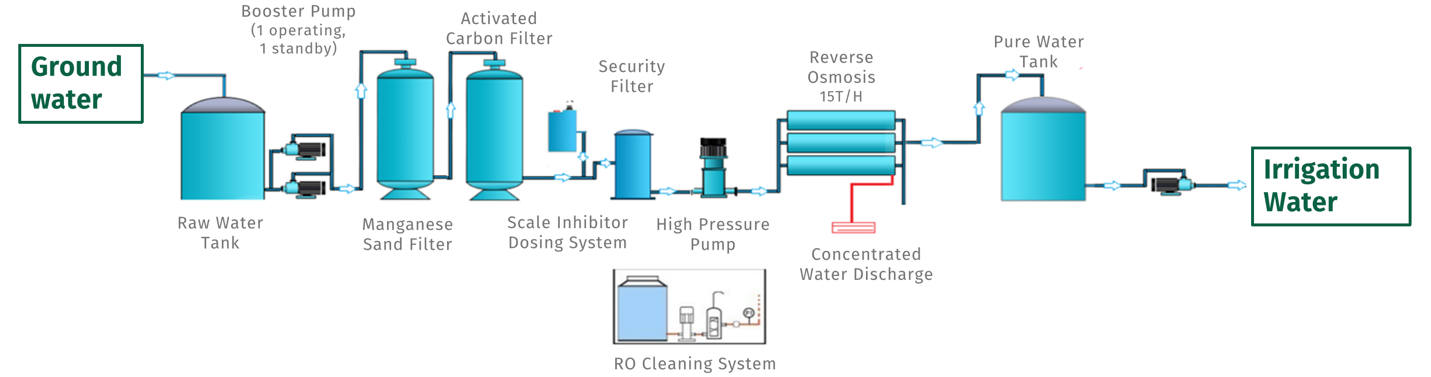
Select quartz sand for solids, manganese media for iron and manganese, activated carbon for organics or residual chlorine, and ion-exchange softening for hardness. Antiscalant dosing and cartridge filtration can protect membranes.
Choose single- or multi-stage RO based on salinity and recovery targets. Consider EDR or controlled blending where appropriate, and add UV disinfection where specified.
Separate treated-water tanks and variable-speed pumps supply each zone at the required pressure.
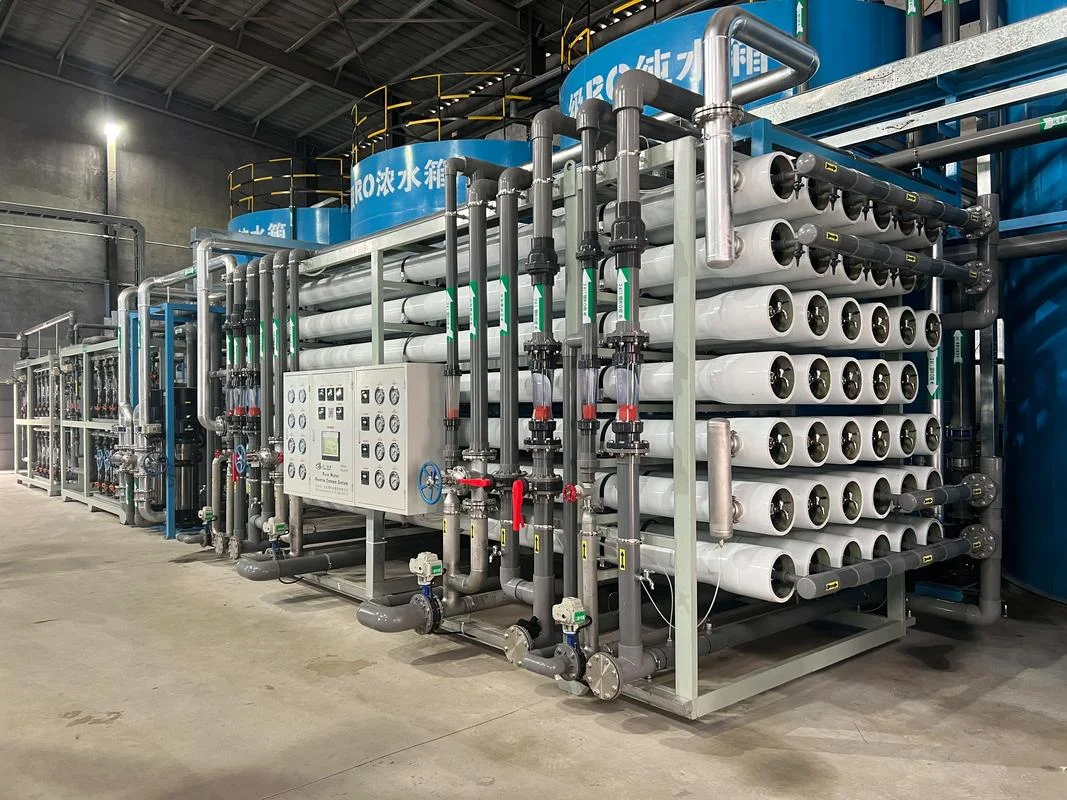
Test for salts, hardness, iron and manganese. Select filtration, softening and desalination from the results.
Account for calcium, magnesium and other minerals when setting the fertigation recipe.
Evaluate desalination or, on suitable coastal sites, a separate heat-exchange circuit for cooling.
Assess disinfection, salinity, sodium adsorption ratio (SAR), crop tolerance and options for blending.
Plan sedimentation, filtration, disinfection and storage around seasonal availability and quality.
Collect suitable crop drainage for filtration, disinfection, temperature conditioning and controlled return.
Use separate recovery circuits where testing confirms suitability for recirculation or return to pretreatment.
Include reject volume in the water balance. Evaluate compatible reuse, further recovery, evaporation or crystallization according to site and discharge requirements.
Compact skid-mounted treatment with raw-water and treated-water storage.
Shared pretreatment, dedicated water grades and duty/standby pumps where required.
Centralized or distributed treatment, separate networks, recovery and reject management, with capacity for expansion.
PLC controls and a bilingual HMI coordinate pumps, valves, dosing and filter cycles. Monitor conductivity, pH, turbidity and temperature alongside flow, pressure, tank levels and RO recovery. Alarms, interlocks and membrane cleaning help protect the equipment. Integrate readings with irrigation and fertigation data where required.
iHavos designs the treatment train, storage and water balance around feed, treated-water, reject and reuse volumes. Baream integrates the equipment and verifies flow and water quality against agreed conditions at commissioning.